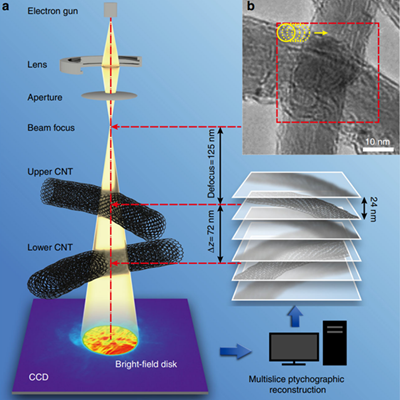
Gao, P. Wang*, F. Zhang*, G. Martinez, P. Nellist, X. Pan, A. Kirkland, “Electron ptychographic microscopy for three-dimensional imaging”, Nature Commun, 8:163 (2017), DOI: 10.1038/s41467-017-00150-1
Electron ptychographic microscopy for three-dimensional imaging
Abstract
Knowing the three-dimensional structural information of materials at the nanometer scale is essential to understanding complex material properties. Electron tomography retrieves three-dimensional structural information using a tilt series of two-dimensional images. In this paper, we report an alternative combination of electron ptychography with the inverse multislice method. We demonstrate depth sectioning of a nanostructured material into slices with 0.34 nm lateral resolution and with a corresponding depth resolution of about 24–30 nm. This three-dimensional imaging method has potential applications for the three-dimensional structure determination of a range of objects, ranging from inorganic nanostructures to biological macromolecules.

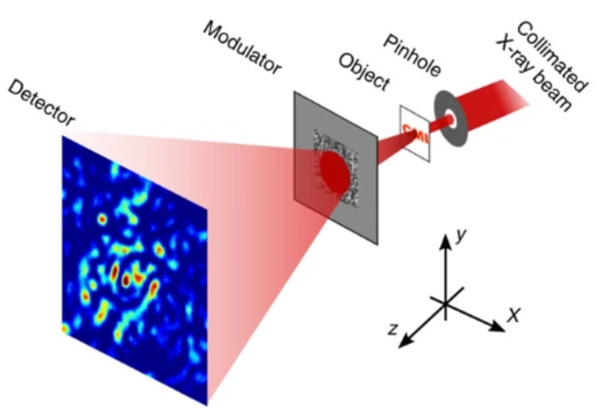
Zhang*, B. Chen, M. Graeme, J. V. Comamala, M. Guizar-Sicairos, I. Robinson, “Phase retrieval by Coherent Modulation Imaging”, Nature Commun. 7:13367(2016), DOI: 10.1038/ncomms13367
Phase retrieval by Coherent Modulation Imaging
Abstract
Phase retrieval is a long-standing problem in imaging when only the intensity of the wavefield can be recorded. Coherent diffraction imaging is a lensless technique that uses iterative algorithms to recover amplitude and phase contrast images from diffraction intensity data. For general samples, phase retrieval from a single-diffraction pattern has been an algorithmic and experimental challenge. Here we report a method of phase retrieval that uses a known modulation of the sample exit wave. This coherent modulation imaging method removes inherent ambiguities of coherent diffraction imaging and uses a reliable, rapidly converging iterative algorithm involving three planes. It works for extended samples, does not require tight support for convergence and relaxes dynamic range requirements on the detector. Coherent modulation imaging provides a robust method for imaging in materials and biological science, while its single-shot capability will benefit the investigation of dynamical processes with pulsed sources, such as X-ray free-electron lasers.

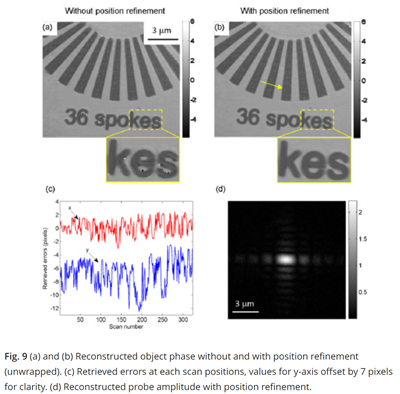
Zhang, I. Peterson, J. Comamala, A. Diaz, F. Berenguer, R. Bean, B. Chen, A. Menzel, I. Robinson, J. Rodenburg “Translation position determination in ptychographic coherent diffraction imaging”, Optics Express, 21, 13592 (2013).
Translation position determination in ptychographic coherent diffraction imaging
Abstract
Accurate knowledge of translation positions is essential in ptychography to achieve a good image quality and the diffraction limited resolution. We propose a method to retrieve and correct position errors during the image reconstruction iterations. Sub-pixel position accuracy after refinement is shown to be achievable within several tens of iterations. Simulation and experimental results for both optical and X-ray wavelengths are given. The method improves both the quality of the retrieved object image and relaxes the position accuracy requirement while acquiring the diffraction patterns.

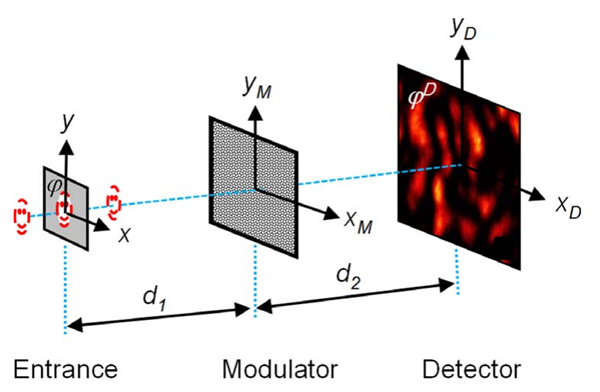
Fucai Zhang, J. M. Rodenburg, “Phase retrieval based on wave-front relay and modulation” Phys. Rev. B (Rapid communication) 82, 121104 (2010).
Phase retrieval based on wave-front relay and modulation
Abstract
We report and demonstrate experimentally an approach to retrieving the phase of a general complex-valued wave field from a single diffraction pattern. The approach employs a modulator in its data acquisition, which greatly reduces the dynamic range requirement of the detector and also greatly facilitates the inverse calculation. The new algorithm, involving a nonlinear modulus constraint, is free from ambiguities and robust to noise; it converges rapidly even with a rather loose support constraint. This approach provides a practical solution to coherent imaging with a broad range of radiations and at all wavelengths.